The last time train drivers were front-page news, the headline figure was £65,000. The public response split between envy and indignation, but both reactions missed the point. That number is not universal, not guaranteed, and not the beginning of the story. A trainee at ScotRail starts on roughly £32,500 and will spend 12 to 18 months proving they deserve to keep the job. A qualified driver at Great Western Railway might hit £52,000 in their first year. Push to the top of the scale at LNER or Avanti West Coast, add overtime and unsocial hours, and £80,000 is achievable. These are different people at different companies doing different sums. Treating train driving as one salary obscures more than it reveals, like treating “footballer” as one wage.
Why the same job pays differently across the network
Train operating companies negotiate their own pay structures. There is no national grade, no Whitehall rate card. ScotRail’s experienced drivers typically sit in the £60,000 to £65,000 band. A London commuter operator or an intercity carrier can run £5,000 to £10,000 higher for equivalent experience. The gap reflects regional cost of living, route complexity, and the bargaining history of each workforce. Some companies run simpler stopping services with shorter routes. Others demand knowledge of hundreds of miles of track, multiple signalling systems, and the concentration to handle a 125mph train in fog.
The trainee-to-qualified jump is where the real financial shift happens. New recruits accept £25,000 to £35,000 during training, a period that can strain household budgets. Pass the assessments, collect the licence, and the salary typically leaps to £45,000 to £55,000. From there, seniority, additional route knowledge, and willingness to work the rosters that others avoid drive the rest. Weekend enhancements, night premiums, and overtime are not bonuses in this job; they are structural components of the pay packet. Some drivers chase them aggressively and others accept them sparingly.
The entry filter is the story
High pay does not mean easy entry. Train driver recruitment is among the most competitive hiring processes in the UK labour market. Some operating companies report acceptance rates of 1% to 2%. This is not a labour shortage; it is a labour fortress.
The process begins with psychometric testing designed to eliminate applicants rather than assess them. The Group Bourdon Test measures sustained concentration through repetitive pattern recognition. Reaction time tests, fault-finding exercises, and abstract reasoning assessments follow. Fail at this stage and there is no appeal, no second attempt this quarter. Pass, and you face competency interviews, assessment centre tasks, and psychological evaluation. The medical is unforgiving: colour perception, hearing, general health, and mental resilience are all screened. Uncontrolled diabetes, epilepsy, or certain mental health conditions typically end the application. The railway does not accommodate risk in the cab.
This intensity exists because the training investment is substantial. Operating companies fund 12 to 18 months of classroom instruction, simulator hours, and supervised driving. A trainee who washes out represents tens of thousands of pounds lost. The screening is ruthless because the cost of getting it wrong is measured in lives and liability, not just budgets.
What the working week actually looks like
The salary compensates for a working pattern that most office workers would refuse. Rosters run 24 hours, seven days. Early shifts can start at 2am. Late shifts finish past midnight. Weekends and bank holidays are standard working days, not exceptions, and the premium pay reflects this reality.
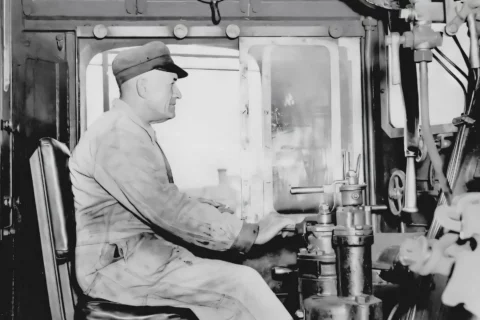
Drivers spend most of their shift alone in a cab, maintaining vigilance without conversation, managing their own alertness through monotony, and ready to respond to signals, speed restrictions, or emergencies in seconds. The responsibility is singular. A driver cannot delegate, cannot consult a colleague in the moment, and cannot blame a subordinate for a mistake. The train, the passengers, the infrastructure, and the schedule are all theirs for the duration.
Overtime is frequently available, particularly during disruption or staff shortage. Many drivers treat it as a regular income component rather than an exception. Two drivers with identical base salaries can report very different annual earnings based on their appetite for extra shifts and their seniority in the overtime queue.
Where the job can lead
Progression exists for those who want it, though many qualified drivers stay in the cab for decades by choice. Instructor driver roles train the next generation, requiring patience and communication skills that the solitary cab does not develop. Driver manager positions move into rostering, welfare, and discipline, trading driving time for administrative responsibility. Specialist roles include high-speed operation on HS1, freight with its different loading and braking challenges, or route conductor work guiding unfamiliar drivers over complex territory.
Each path requires further training, internal competition, and demonstrated competence. The railway promotes cautiously. A mistake in assessment can have operational consequences, so the culture errs toward proving rather than trusting.
How it stacks against other transport work
The comparison with other non-degree transport roles clarifies train driving’s position. Experienced bus drivers typically earn £25,000 to £35,000. The PCV licence takes weeks or months, not years. Entry is faster, turnover is higher, and the responsibility, while real, does not involve sole control of a vehicle carrying hundreds at high speed.
HGV drivers with specialist qualifications, ADR certification for dangerous goods, or long-haul international experience can reach £50,000 to £55,000. The investment is a few weeks of intensive training for the licence. The responsibility is for cargo value and road safety, not for passenger lives in a system where the driver has no escape route and no hard shoulder.
Airline cabin crew, another non-degree role with irregular hours, typically earns £20,000 to £40,000 depending on airline and seniority. The training emphasises service and emergency procedure, not operational control of the vehicle. The pilot holds the corresponding responsibility, and the pilot’s salary reflects it. Train driving occupies a unique midpoint: the control and responsibility of a pilot, without the degree requirement, without the international recruitment pipeline, and with a domestic pay scale that outperforms most alternatives.
The verdict on Britain’s best non-degree career
Train driving is not a hidden shortcut to prosperity. The barriers are real, the selection is brutal, and the working pattern demands sacrifice. For those who pass through the filter, the reward is a salary that competes with graduate professions, progression that can reach management or specialism, and a job that cannot be offshored, automated in the foreseeable future, or devalued by credential inflation.
Whether it ranks among Britain’s best non-degree careers depends on what the individual values. The pay is superior to comparable transport roles. The entry difficulty is higher than most degree courses. The working conditions suit people who can manage solitude, irregular sleep, and intense concentration without external structure. For that specific profile, the money is there, the path is defined, and the competition, while fierce, is at least transparent about what it demands.